
What is e-bike BMS? battery safety explained
- Karl Cowell
- 12 hours ago
- 8 min read


An e-bike BMS, or Battery Management System, is the electronic control unit built into every e-bike battery pack that continuously monitors, controls, and protects the battery during charging and use. The BMS is not optional equipment. It is the reason your battery does not overheat, overcharge, or fail without warning. Safety standards such as UL 2849 and UL 2271 exist specifically to validate that a BMS meets rigorous thermal, electrical, and mechanical requirements before a battery reaches the market. Understanding what an e-bike battery management system does gives you a clear picture of why battery care matters and what happens when things go wrong.
What are the main functions of an e-bike BMS?
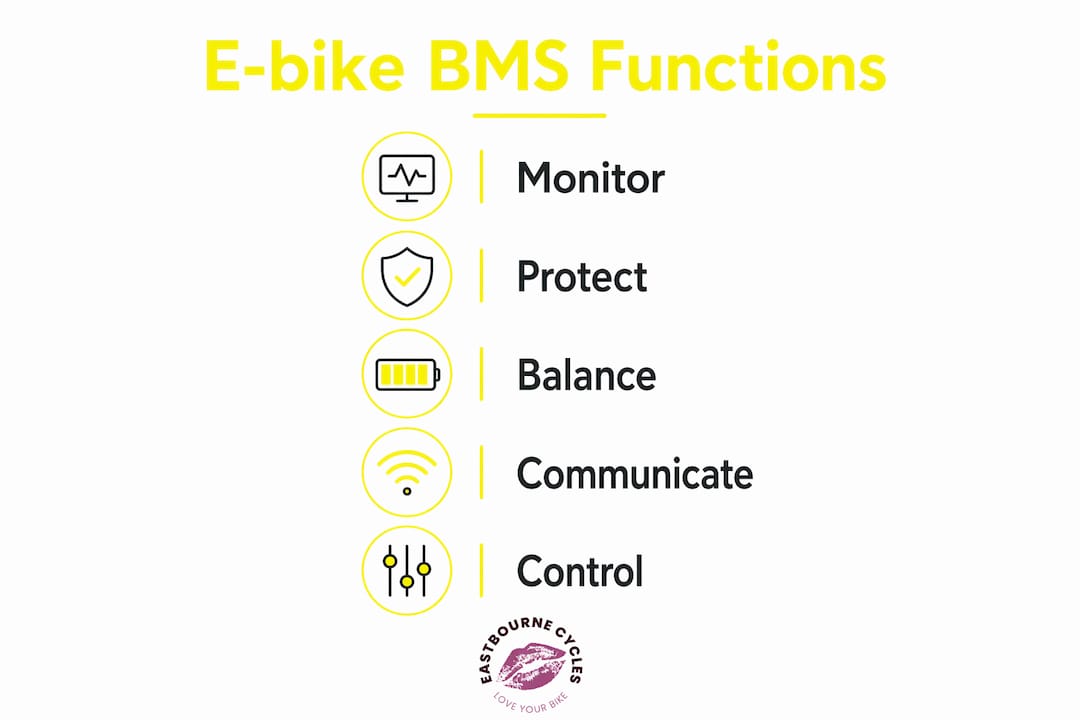
The BMS performs several critical jobs at once, all running silently in the background every time you ride or charge your bike. These functions fall into three broad categories: monitoring, balancing, and protection.
Monitoring is the BMS’s most constant task. It reads the voltage, current, and temperature of every cell inside the battery pack in real time. When any reading moves outside safe limits, the BMS acts immediately. This continuous oversight is what separates a quality battery from a dangerous one.
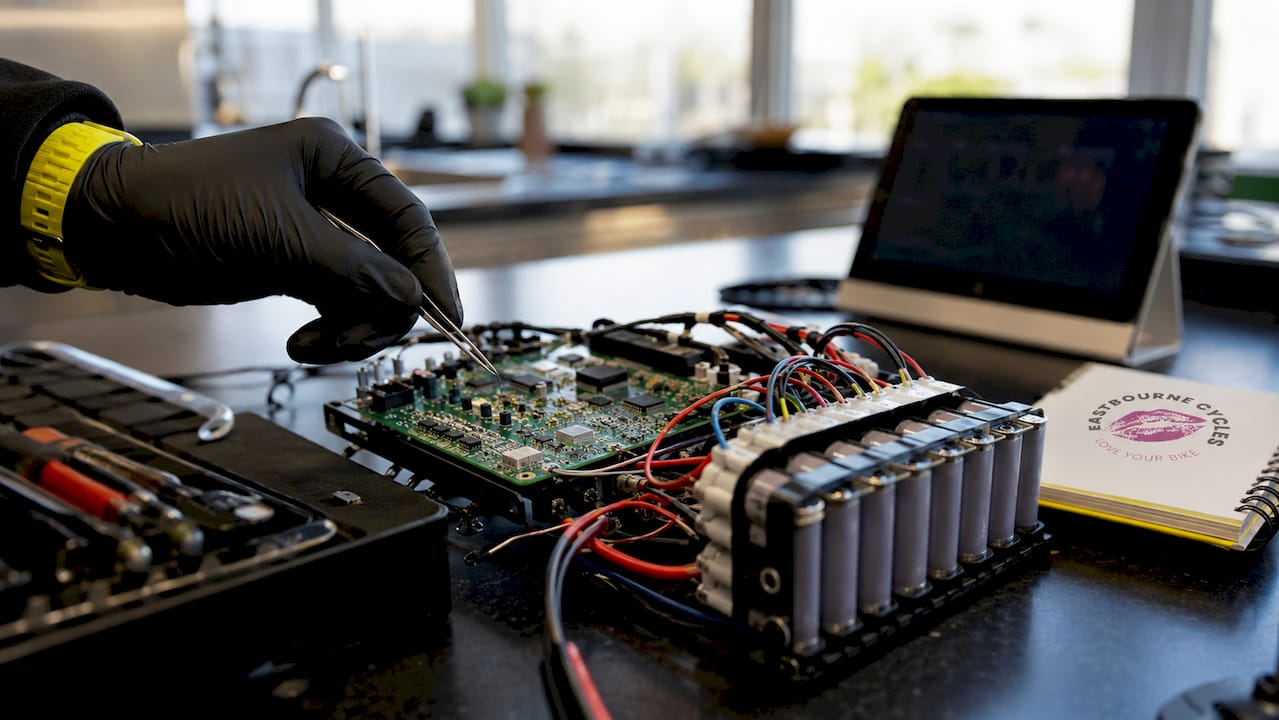
Cell balancing is less obvious but equally important. A lithium battery pack contains multiple individual cells wired together. Over time, those cells drift apart in charge level. The BMS balances battery cells to keep charge levels uniform across the pack. Without balancing, one weak cell can drag down the entire pack’s performance and shorten its lifespan significantly.
Protection features are the BMS’s safety net. These include:
Overcharge protection: The BMS stops charging when cell voltage reaches its upper limit.
Over-discharge protection: The BMS cuts power before cells drop to a critically low voltage.
Overcurrent protection: If current spikes beyond safe levels, the BMS shuts down the circuit.
Short circuit protection: A sudden short triggers an immediate shutdown to prevent fire.
Thermal protection: The BMS monitors temperature and halts operation if cells overheat.
The BMS also communicates directly with your charger and motor controller. It tells the charger when to stop and signals the motor controller to reduce or cut power when conditions are unsafe. This two-way communication is what makes the whole e-bike electronic control system work as one unit.
Pro Tip: Never charge your e-bike with a charger that was not supplied or approved by the manufacturer. The BMS is calibrated to work with specific charge rates and voltage profiles. An incompatible charger can overwhelm the BMS’s protective limits.
Why is a properly certified BMS crucial for battery safety?
A certified BMS is not just a quality mark. It is the difference between a battery that fails safely and one that causes a fire. The consequences of a faulty or tampered battery management system are well documented. Faulty e-bike battery systems have caused serious fire hazards, with 31 fire reports linked to one vendor resulting in significant property damage, often while batteries were in storage. Twelve of those fires caused £734,500 in property damage. That figure illustrates how quickly a compromised battery can escalate from a fault to a catastrophe.
The most dangerous failure mode the BMS guards against is thermal runaway. This is a self-reinforcing heating process where rising temperature causes chemical reactions that generate more heat, which causes more reactions, until the cell vents or ignites. Thermal runaway prevention is a core requirement of UL 2849 certification, which tests batteries for thermal stability, vibration resistance, impact resistance, and electrical fault scenarios.
Certification | What it covers | Why it matters |
UL 2849 | Complete e-bike electrical system including BMS | Tests thermal runaway, electrical faults, and system integration |
UL 2271 | Battery pack for light electric vehicles | Tests cell-level safety, vibration, and impact resistance |
“E-bike batteries are generally safe when well-made, certified, and used with original approved equipment, with the BMS designed to prevent failure risks.”
Aftermarket or modified BMS units present a specific danger. They are rarely calibrated to the exact cell chemistry of your battery pack. A mismatch between the BMS protection thresholds and the actual cell limits means the safety cutoffs may trigger too late, or not at all. Using a non-certified battery or charger voids the protection that UL 2849 and UL 2271 provide.
How does the BMS influence e-bike battery performance and longevity?
The BMS does more than prevent disasters. It actively shapes how long your battery lasts and how well it performs on every ride. Cell balancing is the clearest example. When cells stay at uniform charge levels, the pack delivers stable power output from full charge to low battery. Without balancing, you get an uneven discharge where some cells hit their lower limit while others still hold charge, cutting your effective range short.
Deep discharge is one of the fastest ways to damage lithium cells permanently. The BMS prevents this by cutting power before voltage drops to a damaging level. Similarly, the BMS manages the charging cut-off point to stop cells from sitting at maximum voltage longer than necessary. Both actions reduce chemical stress on the cells.
Your own charging habits work alongside the BMS to determine battery lifespan. Charging to 80–90% rather than 100% reduces chemical stress on cells and improves long-term battery health. The BMS manages cell safety during storage, but it cannot compensate for habits that push cells to their limits repeatedly. Treating your battery gently gives the BMS less work to do and extends the life of the pack.
Pro Tip: If you are storing your e-bike for more than a few weeks, leave the battery at around 50–60% charge. The BMS will maintain cell balance during storage, but a partial charge puts far less strain on the cells than storing at full capacity.
There is one important limitation to understand. Physical damage to cells, such as a puncture or crush from an impact, can bypass BMS protections entirely. The BMS monitors electrical parameters. It cannot detect or compensate for internal cell damage caused by a crash or a heavy object. A battery that has suffered a significant impact should be inspected professionally, even if it appears to be working normally.
For a full picture of how to care for your battery alongside the BMS, the e-bike battery maintenance guide from Eastbournecycles covers practical habits that support long-term battery health.
Common BMS issues and how to avoid them
Knowing the symptoms of a BMS problem helps you respond correctly rather than assuming the battery is dead. These are the most common situations riders encounter.
The battery appears completely dead. Many apparent battery failures are actually BMS safety lock states triggered by deep discharge or cell voltage imbalance. The BMS shuts down the pack to prevent damage. Some units reset automatically once you connect a compatible charger. Others require professional diagnostics to release the lock.
The battery charges but cuts out quickly under load. This often indicates cell imbalance. One or more cells are significantly weaker than the rest. The BMS cuts power when the weakest cell hits its lower voltage limit, even though the other cells still hold charge. Cell balancing during a slow charge cycle can sometimes resolve this, but a professional battery test will confirm whether replacement is needed.
The charger light does not change or the battery refuses to charge. The BMS may have triggered its overtemperature or overvoltage protection. Allow the battery to cool to room temperature and try again with the correct charger. If the problem persists, the BMS may have detected a fault that requires a professional diagnostic reset.
Attempting DIY repairs. BMS units are integrated into the battery housing and are not serviceable by most riders. Attempting DIY BMS repairs or bypassing safety circuits is highly risky and compromises UL safety certifications. Professional battery pack replacement is the correct course of action when the BMS itself has failed.
Using aftermarket chargers or batteries. The BMS is calibrated to specific charge profiles. An incompatible charger can push cells beyond the BMS’s protective range. Always use the charger supplied with your bike or one explicitly approved by the manufacturer.
If you are unsure whether your battery has a genuine cell failure or a BMS-triggered protection state, a battery testing service can distinguish between the two and save you the cost of an unnecessary replacement.
Key takeaways
The e-bike BMS is the single most important safety component in your battery pack, and understanding it helps you ride safely and extend battery life.
Point | Details |
BMS core role | The BMS monitors voltage, current, and temperature to protect cells during every charge and discharge cycle. |
Cell balancing matters | Uniform cell charge levels maintain stable power output and prevent premature battery failure. |
Certification is non-negotiable | UL 2849 and UL 2271 certified batteries have been tested for thermal runaway, impact, and electrical faults. |
Charging habits count | Charging to 80–90% and storing at partial charge reduces chemical stress and supports BMS function. |
Seek professional help | BMS safety locks and suspected faults require professional diagnostics, not DIY repair attempts. |
Why the BMS deserves more respect than it gets
After more than 12 years working with e-bike systems at Eastbournecycles, I have seen the same pattern repeat itself. Riders spend considerable time researching motor power, frame geometry, and range, then give almost no thought to the battery management system. That is understandable. The BMS is invisible. It does its job quietly and you never notice it working.
You do notice when it stops working, or when someone bypasses it. The fire incident data is not abstract. I have seen batteries arrive at the workshop that have been used with third-party chargers for months. The cells are stressed, the BMS has been fighting to compensate, and the battery is a fraction of its original capacity. In a few cases, the BMS itself has been damaged by the mismatch.
My honest advice is straightforward. Buy certified batteries from reputable sources. Use the charger that came with your bike. Do not store a fully charged battery for weeks at a time. And if your battery suddenly stops working, do not assume it is dead. Get it checked before you replace it. A BMS safety lock is not a failure. It is the system doing exactly what it was designed to do.
— Guy
E-bike battery care at Eastbournecycles
If your battery is showing signs of a BMS issue, or you simply want peace of mind before a long season of riding, Eastbournecycles offers specialist diagnostics and battery servicing for e-bike riders in Eastbourne.

The team at Eastbournecycles holds direct relationships with manufacturers including Bosch, Yamaha, and Shimano, which means factory-level diagnostic tools and genuine parts. Whether you need a battery and BMS diagnostic or are considering a new certified e-bike, the workshop is ready to help. Book your appointment or browse the full range of services at Eastbournecycles.
FAQ
What is an e-bike BMS in simple terms?
An e-bike BMS is the electronic control unit inside the battery pack that monitors voltage, current, and temperature to keep the battery safe during charging and riding.
Can a BMS prevent all battery fires?
A functioning BMS prevents most electrical faults and thermal runaway, but physical damage to cells such as a puncture or crush can bypass its protections entirely.
Why does my e-bike battery show as dead when it is not?
Many apparent failures are BMS safety locks triggered by deep discharge or cell imbalance. Professional diagnostics can distinguish a safety lock from genuine cell failure.
Is it safe to repair a BMS myself?
No. BMS units are integrated into sealed battery housings and are not designed for user repair. Attempting to bypass or repair the BMS creates a serious fire risk and voids safety certifications.
How often should I have my e-bike battery checked?
An annual professional inspection is good practice, and any battery that has suffered an impact or shows unusual charging behaviour should be assessed promptly regardless of age.
Recommended

Comments